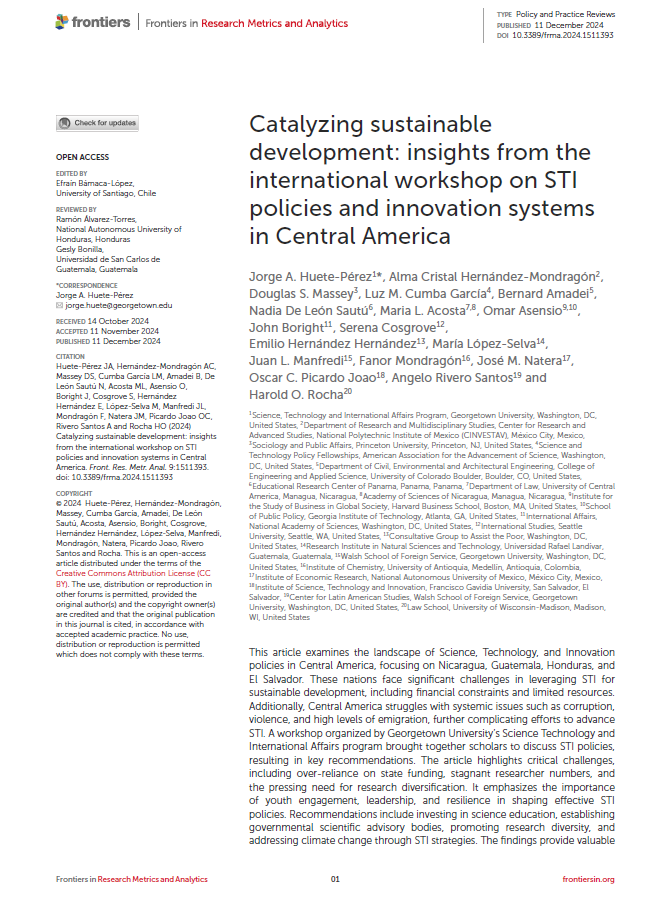
Autor(es): Alma Cristal Hernández-Mondragón, Angelo Rivero Santos, Bernard Amadei, Douglas S. Massey, Emilio Hernández Hernández, Fanor Mondragón, Harold O. Rocha, John Boright, Jorge A. Huete-Pérez, José M. Natera, Juan L. Manfredi, Luz M. Cumba García, María L. Acosta, María López-Selva, Nadia De León Sautú, Omar Asensio, Oscar C. Picardo Joao, Serena Cosgrove
Palabras clave: capacity building, Central America, science-diplomacy, STI policy, sustainable development
Instituto: Iarna
Año: 2024
Tipo de documento: Artículo científico
Tipo de revista: Revista indexada y revisada por pares
Nombre de revista: Frontiers in Research Metrics and Analytics
Páginas: 1-14
DOI: 10.3389/frma.2024.1511393
Resumen:
This article examines the landscape of Science, Technology, and Innovation policies in Central America, focusing on Nicaragua, Guatemala, Honduras, and El Salvador. These nations face significant challenges in leveraging STI for sustainable development, including financial constraints and limited resources. Additionally, Central America struggles with systemic issues such as corruption, violence, and high levels of emigration, further complicating efforts to advance STI. A workshop organized by Georgetown University’s Science Technology andInternational Afairs program brought together scholars to discuss STI policies, resulting in key recommendations. The article highlights critical challenges, including over-reliance on state funding, stagnant researcher numbers, and the pressing need for research diversification. It emphasizes the importance of youth engagement, leadership, and resilience in shaping effective STI policies. Recommendations include investing in science education, establishing governmental scientific advisory bodies, promoting research diversity, and addressing climate change through STI strategies. The findings provide valuable insights for scholars, policymakers, and international organizations working with less developed nations globally.